Thursday, July 19, 2012

FILM 13: PICASSO / BRAQUE / GLIMCHER


“Picasso & Braque go to the Movies” is unlike the other films we have watched thus far. First off, this film talked about the influence of cinema on painting, rather than just photography. The film had clips of very old movies that inspired Picasso and Braque. Also, those who were interviewed were film makers, critics, historians, and artists. There was no single host of the show like all of the other films we have viewed thus far. These qualities along with a great topic create a very interesting film. So far, this is my favorite film we have viewed. The five most effective ways that Arne Glimcher delivers information in this film are through interviews, old film clips, paintings by Picasso and Braque, the work of those interviewed in the film, and comparisons of Picasso and Braque. I found the interviews most effective followed by the old film clips, paintings by Picasso and Braque, the comparison between Picasso and Braque’s artwork, and finally the work of the artists interviewed in the film.


The “mountain climbers” are Picasso and Braque. A poet named Guillaume Apollinaire introduced the two artists. They worked together, but on separate paintings. It was said that Picasso did not finish a single painting without Braque looking at it first and vice versa. This story is unlike anything we have seen thus far because instead of two artists competing, Picasso and Braque are working together like a team of mountain climbers. Da Vinci and Michelangelo are compared and contrasted and considered competitors. Goya and David were weighed against one another. Picasso and Braque complimented each other.


Martin Scorsese is an award winning and world renowned film maker known for his use of film rather than digital. Chuck Close is an artist known for his photorealist works (Wikipedia). Julian Schnabel is both an artist and a filmmaker. Eric Fischl and Lucas Samaras are both artists as well. All of these artists are interviewed in the film and provide insight about numerous aspects of cubism and cinema. Many of these men are inspired by early cinema or cubism. Also, many of these artists are pioneers in their respective fields. In my opinion, Martin Scorsese’s final words in the film gave the most insight. He stated that Picasso and Braque tore “down the conventions of representation”. These two men did not stick with the norm and paint exactly what they saw. They changed the art world and put their own spin on things. Scorsese also said that “cubism is not a style, it was a revolution that instigated a profoundly radical change of artistic form. In fact...a radical change of vision itself.” These words helped me understand cubism even more. It makes much more sense now. Before, I looked at cubism and thought that it was weird and hard to understand. Now, I realize that when you piece each section together and see what the artist is saying, it really is just a different, more interesting way of looking at something rather simple.


Question: Do you enjoy the fact that these two artists produced paintings that look a lot alike? Or does this bother you?

Saturday, July 14, 2012

FILM 12: IMPRESSIONISM / COLLINGS


I prefer last week’s video by Collings because I found the David and Goya comparisons much more interesting. Both videos were presented in a similar way, but it was simply the content of last week’s video that was more interesting to me. The most interesting thing that Collings said this week was that impressionists thought that “art should be real, not false”. I found this interesting because of its truth. When you look at impressionist paintings, nothing is beautified like much of the art we have looked at. It is simply an image of what the artist sees. It is honest and sometimes flawed, but never embellished.


In my opinion, all of the paintings featured in the film are exceptional, but one that I was unfamiliar with was my favorite. Paul Cezanne’s “Mont Sainte Victoire” series was painted in the 1880s using oil paint. These paintings are extremely eye catching. The vibrant colors and the slightly messy brushstrokes make your eye jump all over the canvas. The first thing I notice is the mountain and then I notice the trees in each scene. My favorite of the series is the photo I included. I like this one the most because of the bright colors and the way the trees are painted. These scenes of mountains in France are truly some of Cezanne’s most exceptional work.


Realism was the type of art that preceded impressionism. This art was very much straightforward and slightly boring. The work was as close to reality as the artist could get. Impressionism, on the other hand, painted in an almost messy way with small, quick brushstrokes and when you look closely at the scene, it is not realistic. These paintings are much more pleasing to the eye and were often of beautiful scenes or people outdoors enjoying themselves. I think that the impressionist movement is a step in a positive direction because art does not have to be perfect or exactly how the subject matter appears in real life. I enjoy art that is more of an interpretation of what the artist sees rather than an exact replica of a scene. Impressionism does just that, and for this reason I believe that art was definitely moving in the right direction. These paintings are most definitely “nice”, as Collings said. The softer colors, brushstrokes, and beautiful scenery are what contributes to the overall niceness of impressionism.


Question: Do you prefer realism or impressionism?

Friday, July 13, 2012

FILMS 11: Gauguin and Degas / Marlow


I chose Paul Gauguin and Edgar Degas. Paul Gauguin is an artist that I am unfamiliar with but wanted to learn more about after watching the Van Gogh film in which he was mentioned a lot in. I chose Degas because I was familiar with a few of his paintings but never learned much about him in previous art classes.


In my eyes, Gauguin’s most interesting painting is “Les Alyscamps” which was painted in 1888 using oil on canvas. This painting is extremely colorful and because of this fact, it controls your eye. There are also a lot of things to look at, like the water, the trees, the people, and the building in the background.


My favorite Degas painting is “Rehearsal on Stage”. The dancers really interest me because they almost look like ghosts. The colors used to paint them caught my eye. Their facial expressions also show that they are almost caught in a scene so as a viewer, you feel like you are just observing their actions. Finally, the man who is seated in the background catches your eye because of the fact that he is the only one not dancing.

These two paintings differ because they are of vastly different scenes. Gauguin’s work is more colorful and scenic while Degas’ painting is a captured moment that is painted in more neutral tones. The people in the Degas painting are more realistic while in the Gauguin painting, things seem almost like a fantasy because of the lack of the extreme detail and the use of many vibrant colors.


Marlow simply tells the story and displays the paintings of each artist. He is very straightforward like Hughes is. Unlike Schama, Greenaway, and Hockney, there were no reenactments or dramatic lighting. These short biographies were just as effective as the other films, but I would have enjoyed getting more in depth because I knew very little about each artist. I still think that Hughes is the best storyteller but I like Marlow a lot as well. They are both straightforward and informative. They sometimes do not even need the reenactments to help tell their stories.


Although Degas’ eyesight deteriorated as time went on, do you think his paintings truly suffered or were they just as interesting?


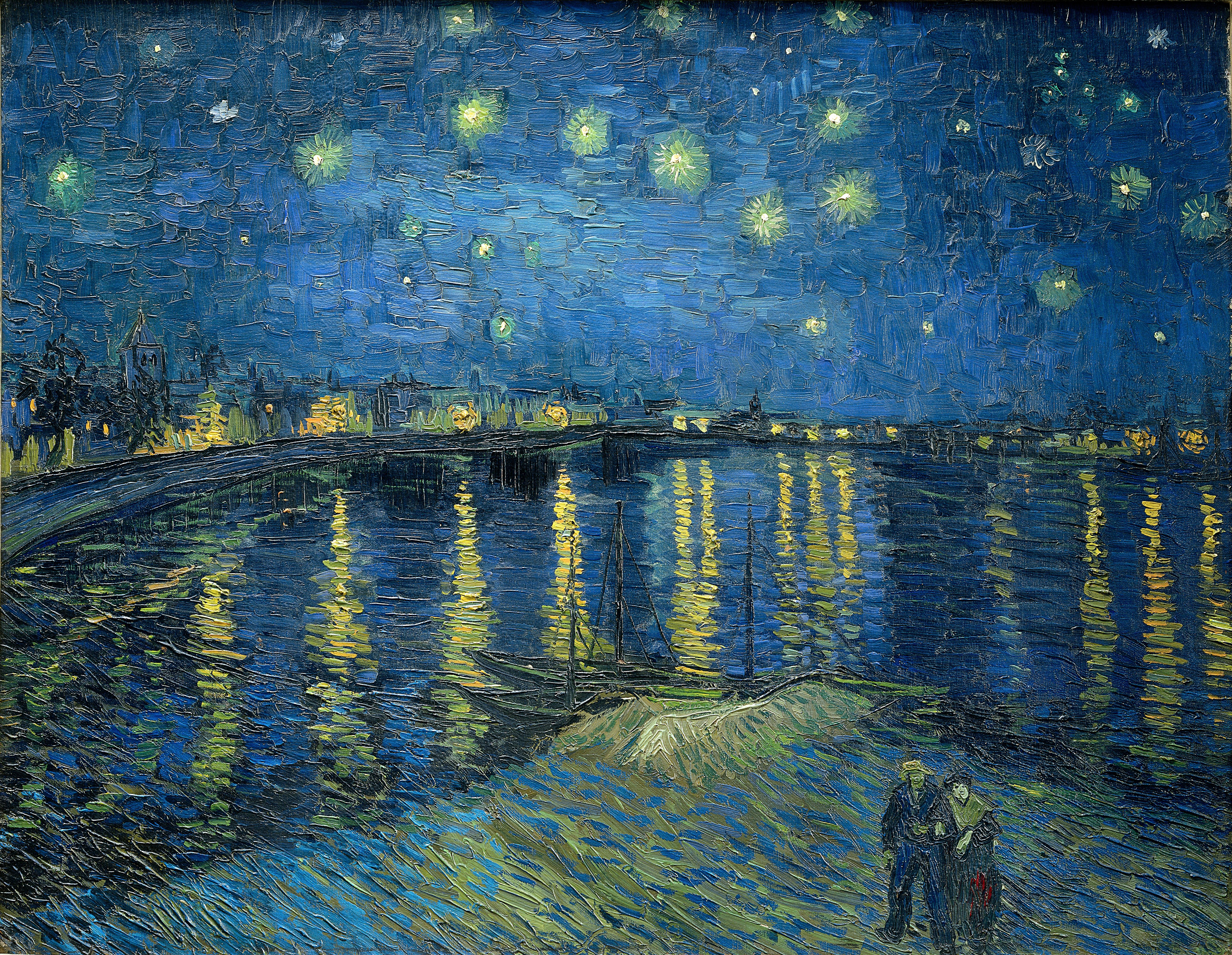
FILM 10: VAN GOGH / SCHAMA


In this film, Schama did not employ some techniques that he used in his films about David and Caravaggio, but there were some similarities. First off, Schama did not use history to provide background like he did in David’s story where he used the French Revolution as the backdrop. Also, reenactments were not used like they were in Caravaggio and David’s stories. The reenactments in the Van Gogh film were only of Van Gogh himself. They were almost like interviews rather than scenes of Van Gogh’s life. One similarity that the three films have is the use of dramatic lighting. The actor who played Van Gogh was filmed in a dimly lit, dingy room. This was probably to go along with Van Gogh’s dark personality and insanity. Overall, Schama’s films all have similarities, but portray each artist in vastly different ways.


I like Van Gogh the most because he is by far the most interesting of the artists that Schama talks about.  His insanity is intriguing and I felt bad for him at certain points. He wasn’t crazy like Caravaggio was, but he was a lot more interesting than David. I might be biased because Van Gogh was already one of my favorite artists before watching this, but I only knew a little about him. Now I am extremely interested in learning more about him because of this film.


It is really difficult for me to chose a favorite painting by Van Gogh, but one of my new favorites after looking at a long list of his works is Van Gogh’s “Skull with a Burning Cigarette”.  This work was done in 1886 and is oil on canvas. I had seen this painting on a book cover but never realized that it was Van Gogh’s work. I always loved how strange it is and always found this painting very interesting. It is so simple but could mean many things. This could easily be used for a campaign against smoking. It also makes me think because Van Gogh sometimes painted himself with a pipe in his mouth. This could be like a self portrait, but it most likely is not. It is still fun to try and think of what Van Gogh is trying to say with this painting. When I look at it, my eye is drawn to the skull of the skeleton because of the brush strokes. Then I notice the cigarette and finally the ribcage and other bones of the skeleton’s chest. It controls your eye because of the brush strokes and the pure fact that it is an unusual painting.


I don’t think painting every day necessarily made his painting better or worse. Some of his work is well known and some of it isn’t, it just happens that way. They are all unique and equally as interesting. Van Gogh’s work was evolving each day and I think that he needed to paint to cope with whatever insanity he was suffering from. There was no harm in him painting a new picture each day.


If I were to paint each day I feel like I would go insane, just as Van Gogh did. I can’t consistently do something that intense each day.  I am not really a person who likes extreme repetition. It can be so time consuming and tiring to have to think artistically that often. It may just be that I am not an artistic person, but I don’t think it would be that beneficial. I know that “practice makes perfect” but perfection is not always the best quality of art. The imperfections make things interesting as well. Van Gogh’s art was imperfect, though, and it might have just been an outlet for him instead of a practice type thing. I think this strategy works for him, but would not work for me.


Question: What do you find most interesting about the style in which Van Gogh paints?

Saturday, July 7, 2012

FILM 9: CIVILIZATION / COLLINGS


Matthew Collings is an art critic, artist, and writer. Collings attended school at Byam Shaw School of Art and Goldsmith’s College.  We should believe Collings because he is an educated art critic and artist himself. He hosts the series “This is Modern Art” which he won awards for, and has also written and hosted various TV programs and books on art.


Collings chose to discuss a wide range of art history probably because he wanted the audience to have some sort of background so that they understood the period of art that Goya and David were a part of. I think it is important to see this because it will help the audience further understand the work that these two artists created. His point was to just give background and a further explanation of the period so that the audience was not left to make their own assumptions. Also, Collings stated that events like the French Revolution inspired these artists, and that is important to include as well, especially for David because he painted propaganda for the Revolution.

Collings uses history and his own narration to tell his stories. He has to use history as a part of the storytelling because if he did not give background, the audience may not understand the entire film. Many people are unaware of Goya and David’s background and inspiration, so this is necessary information to include. Also, within the element of history he compared the work and motivation of David and Goya. Collings was the first of the storytellers to talk about two artists in one film, which was interesting. Like Hughes, Collings did not have reenactments or other dramatic elements. In Collings’ case, this made the film a little dull in my opinion. He was not my favorite storyteller. Hughes, however, got away with not using many elements that the other storytellers used, which I liked. Hughes is still my favorite storyteller because of the passion he has for Goya and his straightforward delivery of information.


The image I think my generation will be represented is the iPhone. We are a technology thriving generation and the iPhone is really what started this revolution. Ever since the creation of the iPhone, other technologies have increased as well. This will say that our generation is extremely intelligent and adaptive, but also beginning to lack in social abilities. We are becoming more reliant on technology and that is not always a positive quality. It is a truly bittersweet thing. There are so many helpful products in medicine and communication, but we are often harmed by the fact that we no longer have as much face-to-face communication. Future civilizations will see this and note it as the change from being a very social civilization to a more isolated, technology focused civilization.


Question: What was the most beneficial element of Collings’ storytelling techniques as compared to the other narrators thus far? Do you like that he does not use reenactments or do you think he should include them?

Friday, July 6, 2012

FILM 8: GOYA / HUGHES


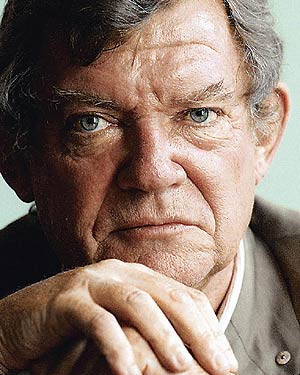
Robert Hughes is an Australian art critic and writer. Hughes has written for many prominent newspapers including The Daily Telegraph and The Times. In 1970 he became an art critic for TIME magazine, which is where he began his work in New York. This job also is how Hughes established himself as an influential art critic. Hughes has also done a lot of work in television making series about various artists.  His stories are believable because Hughes has established himself as a credible critic of art. All of his achievements contribute to his credibility, especially the art related awards he has received, like a membership to the American Academy of Arts and Sciences and the Frank Jewett Mather Award for art criticism in 1982 and 1985.


I believe Goya’s most interesting painting is La familia de Carlos IV. This painting was made in 1800 using oil on canvas. This is a painting of the royal family of Charles IV of Spain. The first thing I notice is Charles IV because of the way he is standing. Next, I notice his wife, Queen Maria Luisa. Finally, my eye is drawn to Fernando VII because the light seems to hit him in an interesting manner. The painting controls your eye because there is so much to look at. You may notice all the people first but then later look at their facial expressions which are all very interesting. There are large paintings in the back and even Goya himself. This painting is large and can truly make you look for a long time.


Hughes told his stories by telling them himself. He also interviewed a few people. Unlike the other hosts, he didn’t use historical reenactments or lots of interviews. He talked about Goya himself and showed the paintings, museums, and locations in Spain where Goya resided. So far I think Hughes is the best storyteller because of the passion that he has for Goya’s work. He really is unlike any other storyteller so far. You can tell that he truly loves what he is talking about and that helps as a viewer because all the information is straightforward and also full of interesting ideas. Hughes does not need all the flashy reenactments that most of the other storytellers used because the words he speaks are just as effective.


Question: Which of Goya’s works do you prefer: the ones before his illness struck, or the darker ones after his sickness struck?

Thursday, July 5, 2012

FILM 7: DAVID / SCHAMA


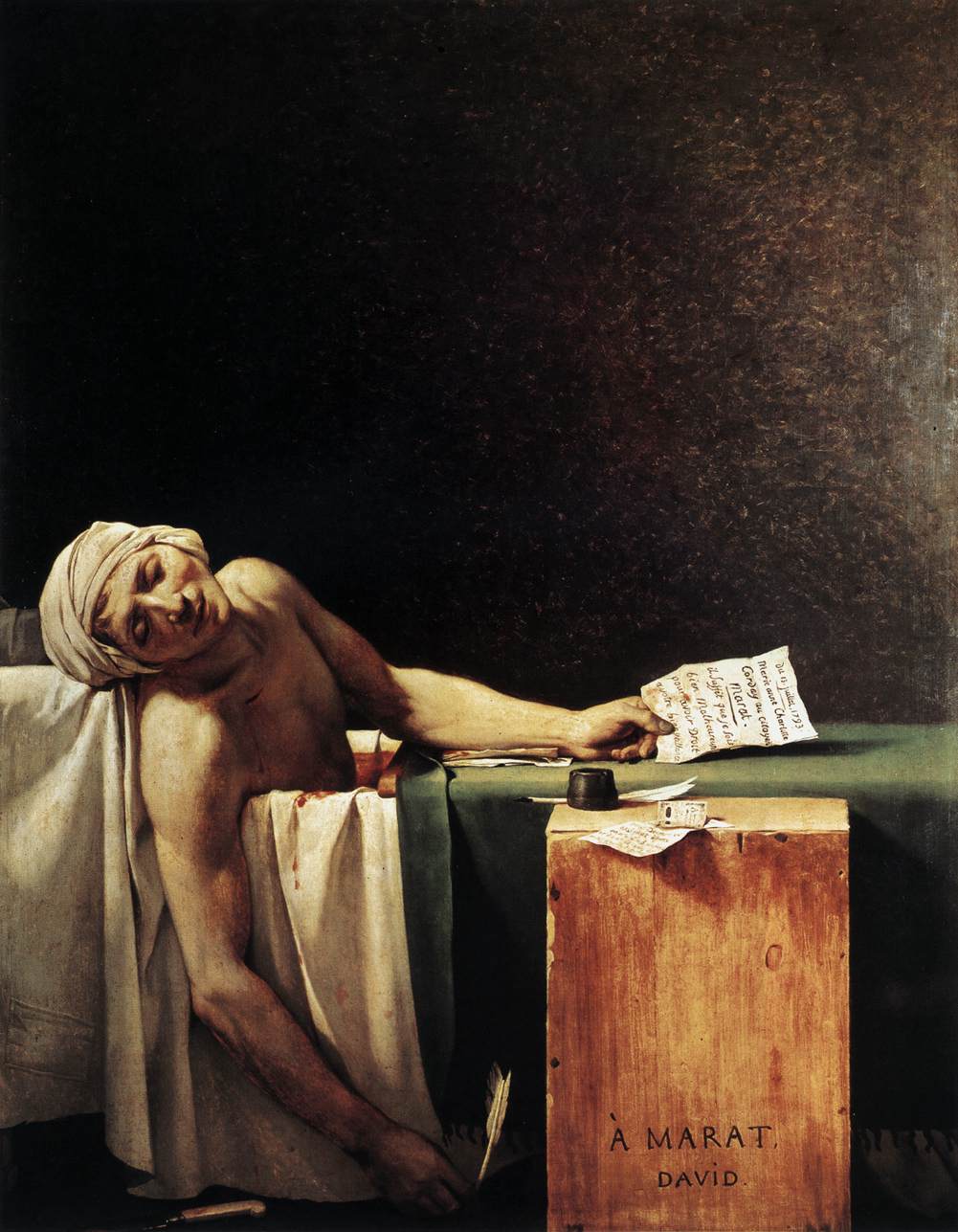
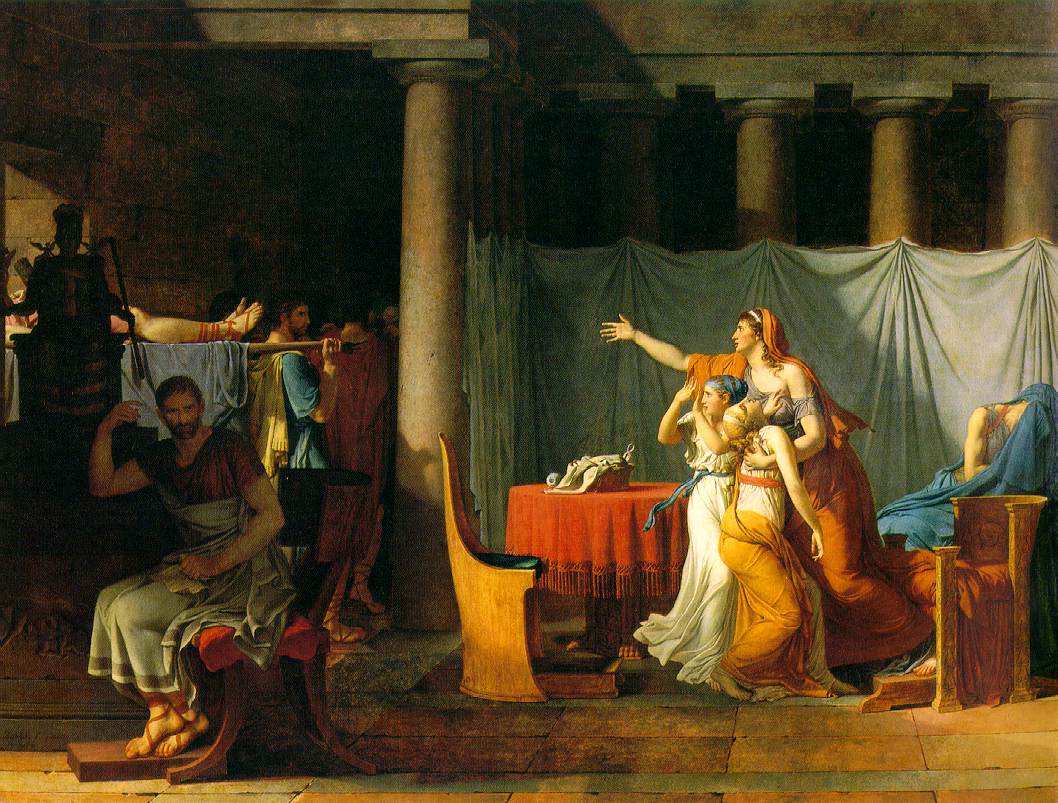
Schama approached David differently in the way that he focused more on the history of the time. The French Revolution was the backdrop for David’s story. In Caravaggio’s story there was more of a focus on what he was doing and not so much the history of the time. I think it was important for David’s story to be told this way because the French Revolution is what really propelled David and his career. The two films were the same in that there were still reenactments and dramatic lighting used to tell the stories. The reenactments in David’s story were more of historical events rather than David’s life. The dramatic lighting helped show how the Revolution was a very dramatic period. Also, you could really tell that Schama did not like David - he even said so at one point. This seemed to effect the light in which he approached David. Caravaggio killed someone, David painted about someone being killed. Schama made it seem like it was the opposite.


In my personal opinion, David’s The Death of Socrates is the most interesting painting because it is David’s take on a historical event that has interested me after taking Philosophy last semester. It was painted in 1787 with oil paints on canvas. The painting is 51inches by 77.2 inches. It controls your eye because of the subject matter. It depicts Socrates before he ingests hemlock as a death sentence. Socrates is the one sitting on the bed while his two friends, Plato and Crito sit with him. Socrates is pointing up toward heaven. I think this is Socrates showing that he does not really fear the death sentence he has chosen over being exiled. After reading both Apology and Crito, this painting really interests me. Socrates catches my eye first because he is a striking figure right in the center. The next thing I see is the group of people reacting to the event behind Socrates. I am assuming that Crito is the man with his hand on Socrates’ knee because it looks like he is still pleading with Socrates to chose exile over death. All in all, I find this particular painting to be one of the most interesting paintings done by David.


I think David is a decent person. I do not think that David was doing anything wrong. His paintings tell what he sees as the truth, and that is what most artists do. It does not really matter because he was not a criminal, he just created art that stirred people’s emotions. He lived during a time where people were doing much more terrible things like executing people. All David did was paint propaganda for the French Revolution.


Question: Do you think that Schama approached this video on David negatively because he personally is not a fan of David's? Could you see that he made David seem like a bad person more so than he portrayed Caravaggio (who actually killed a man)?